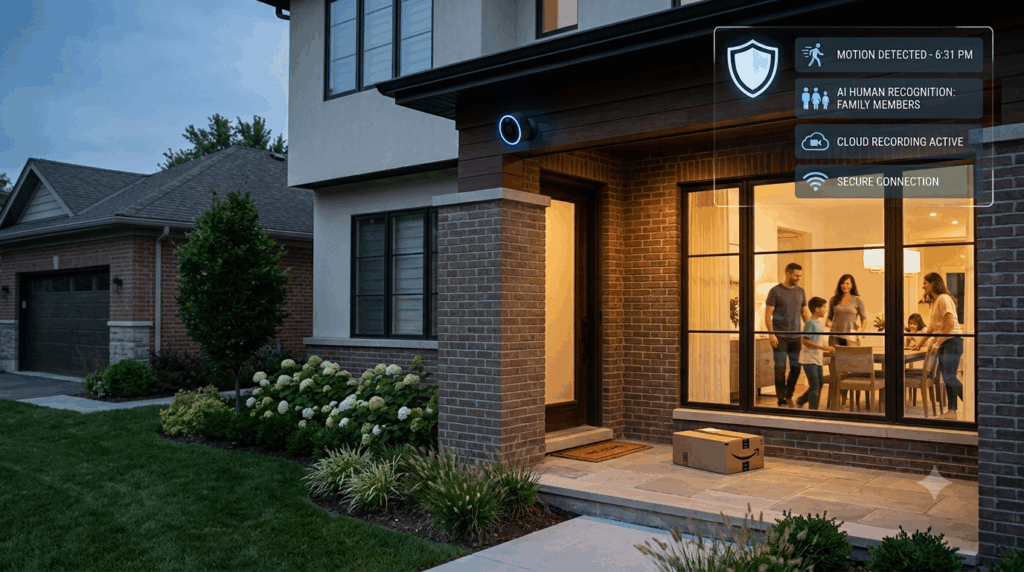
When it comes to securing your home, you need a strategy that goes beyond passive property recording to property protection. Instead, you need to implement high-tech Motion Detection Surveillance architectures that protect, analyse, and neutralise threats before they become an issue at Complete Protection Solutions. Whether you’re a homeowner or a commercial property manager, the first step to absolute peace of mind is knowing how modern sensors fit in with live monitoring networks.
This one-stop resource explains smart sensors, the benefits of managed monitoring, and the building of a bulletproof defense system that suits your environment.
1. The Mechanics of Motion Detection Surveillance.
It is not a photo-detector security system that has an astigmatic effect with every leaf that goes by a lens. It’s not a primitive photo-detector type of security system that causes false alarms when a leaf flutters past a lens. Today’s systems are built with a combination of multi-spectrum sensors and algorithmic filters to verify every alert and make it actionable.
Core Sensor Technologies
- Passive InfraRed (PIR): These sensors detect the infrared radiation from a specific area. When the heat energy changes sharply and in an individual spot, as when a person walks across the line of sight, the system is immediately activated.
- Microwave (MW) Sensors: These sensors continuously broadcast radio waves of high frequency and measure the profile of the reflection pulse, which allows for detection of changes in the volume of the structure in space.
- High-security sectors use a PIR and MW sensor combination to virtually eliminate expensive false alarms. The system only trips if both technologies validate the intrusion sequence at the same time.
- The specialized smart motion sensors, when integrated into your perimeter grid, create a proactive digital fence line and change the way you approach security from reactive post-incident review to real-time threat mitigation.
2. Here’s the Power of Monitored Surveillance Cameras in Colorado Springs, CO.
The local environment requires context-sensitive, resilient security deployments. To deploy monitored surveillance cameras in Colorado Springs, CO, the hardware must be designed to withstand the changes in weather conditions that occur quickly in Colorado Springs, CO, and still be able to provide high-fidelity streams in real-time.
If there is a motion-activated security system, it is not just a matter of saving its raw footage to a local hard drive. Rather, a compressed, high-definition data packet is sent immediately, through encrypted channels, to a monitoring station in the central location.
This infrastructure connects the basic hardware to real 24/7 surveillance monitoring. With the live feed viewed at the same time by trained security staff, they are able to filter out the normal environmental ‘noise’ when a danger is reported, such as shifting shadows or regional wildlife, and only alert local emergency services when a real security threat is detected.
3. The design of a Semantic Video Surveillance System
Key components in an Enterprise-Class Video Surveillance System are edge devices, local storage nodes, and the cloud management dashboard. Whether you need a commercial system upgrade or Home Security Monitoring in Colorado Springs, CO, your network configuration needs to be able to maximize bandwidth and ensure high-fidelity visual capture.
Key Architectural Elements
- Closed-circuit integration to a CCTV motion detection system boasts intelligent network video recorders (NVRs) that provide server-side pixel-change analysis and line-crossing detection.
- Wireless cameras are perfect for an urgent deployment or difficult retrofits, offering robust wireless connections on secure Wi-Fi 6 or cellular backup bands, and transmitting high-bitrate video feeds without compromising physical cabling.
- With syncing capabilities, a motion alarm can send a signal to a Z-Wave or Zigbee smart home security hub, which can then activate other features like floodlights outside the home or lock a specific access control point.
4. How to get the most out of Real-Time Surveillance Alerts to improve ROI
Lag time is the biggest weakness of unmonitored systems. If there is no audible alarm coverage, a standalone alarm system may sound a warning, but no one will hear.
When you send your hardware to an advanced security monitoring system located in Colorado Springs, CO, you gain access to full remote security monitoring.
| Function | Not Monitored | Monitored by Professionals |
| Response latency | Manually checking the status of notifications on the phone | Immediate verification of threat, within seconds of sensor trigger. |
| Alert accuracy | High number of false alarms from pets, weather, or debris. | Multi-layer validation through AI filter and live agent review |
| Emergency dispatch | Manual dialing of local authorities after verification | Prioritized calling of local authorities. |
Once a perimeter sensor is triggered, real-time surveillance alerts are sent at the same time to your mobile device and to our dedicated monitoring experts. In the case of an anomaly being verified, operators can use audio-talkback features to alert the intruder, or directly notify local authorities of verified situational data, thereby minimizing response time.
5. Security camera installation Colorado Springs CO.
Even the most technically advanced equipment on the market is worthless if not set up correctly. To install a security camera system in Colorado Springs, CO, it’s essential to have a thorough understanding of the local landscape, the vulnerabilities of the structures, and the ideal angles for capturing footage.
FAQs:
1. What is it about smart motion sensors that can differentiate pets from real intruders?
Most modern sensors employ mass configuration, spatial geometry, as well as algorithmic processing.
2. Does a motion-activated security camera give false alarms during the winter due to snow or fog?
Advanced systems use analytics such as object classification and crossing-line logic, which can not be fooled by extreme weather, whereas basic pixel-matching software may be fooled.
3. How do I receive alerts and alerts if internet connection or the power grid is down with my remote security monitoring?
Redundant backup infrastructure is used in professional installations. Local battery backups and critical camera communication modules are utilized in the core control panels and critical cameras to ensure that your property remains safe even if the utilities are down.
4. Can a wireless security camera system be jammed?
Yes. The high-level wireless systems include end-to-end encryption and spread-spectrum frequency hopping. In case the system detects a deliberate attempt to cause signal interference, the system automatically activates a local tamper alarm and informs the central monitoring station through an alternate line.
5. Why opt for 24/7 surveillance monitoring over self-monitoring applications?
Without self-monitoring, dangerous situations could be caused by dead batteries, low cell phone reception, or when you are asleep or driving.